

Is sustainable corporate gifting worth the extra cost?
Is sustainable corporate gifting worth the extra cost?
Yes, when the extra spend buys a gift your recipient wants to use and sourcing evidence you can check. It is not justified by an eco-friendly label alone. Compare the complete order, including personalisation, packaging, delivery and administration, before approving a higher product cost.
- Is sustainable corporate gifting worth it? Yes, when recipient usefulness and verified sourcing justify the extra spend.
- Compare sustainable corporate gifts on the complete order, not the headline product cost.
- Choose fewer useful items rather than adding branded merchandise to fill a box.
- the ethical gift box serves businesses buying sustainable, customisable gifts for employees and clients.
Is sustainable corporate gifting worth the extra cost?
Pay more for a clear improvement, not a broader claim. A stronger material specification, documented sourcing or a gift that fits the recipient can justify additional spend. A generic sustainability description does not tell you what has improved.
Start with the same brief for every supplier: the same recipient group, quantity, branding requirement and delivery destination. The guide to setting a corporate gift budget provides a useful next step before comparing proposals.
Use this table to distinguish approaches. These are buying options, not claims that any particular supplier delivers better results.
| Buying approach | Suitable for | Potential advantage | Limitation to check |
|---|---|---|---|
| Lowest-cost compliant gift | A brief with a firm spending limit | Keeps the initial commitment within budget | Check usefulness, construction and the complete order scope |
| Evidence-led sustainable gift | Buyers who need to substantiate sourcing claims | Gives procurement specific information to assess | Evidence still needs checking against the actual item |
| Smaller, considered gift selection | Teams reducing unnecessary contents | Concentrates the budget on items with a clear purpose | Fewer contents will not suit every occasion |
| Existing stock or no physical gift | Recipients who do not need another item | Avoids buying something without a clear use | Requires a different way to communicate appreciation |
The sustainable option should pass your ordinary quality and suitability checks as well as your sourcing checks. If it does not, revise the brief rather than accepting a poor fit because the material sounds preferable.
Why this matters
Corporate gifting puts a purchasing decision directly into someone’s hands. Your recipient experiences the contents, the personal message and the effort required to use or dispose of the gift. They do not experience your procurement presentation.
For a 2026 gifting programme, separate the reason for sending a gift from the reason for choosing its materials. An onboarding gift should help someone feel welcomed. A client appreciation gift should express thanks without creating an awkward obligation.
Neither purpose requires a large box. Start with what the gesture needs to accomplish, then decide what belongs inside it. This keeps sustainability connected to a practical buying decision rather than a separate label added at the end.
What should you compare before paying more?
Ask suppliers to describe the same complete order. Otherwise, a proposal that includes packing and delivery sits beside one that covers only the undecorated item, and the comparison tells you little.
Recipient usefulness
Write down how the recipient would use the gift. Be specific: a bag for commuting, drinkware for a desk, or a consumable chosen around known dietary requirements. A material claim cannot compensate for an item that has no place in the recipient’s routine.
Check what people already have. Sending another version of a well-supplied office essential needs a clearer reason than choosing an item that fills an actual gap.
Sourcing evidence
Ask what the claim means and what supports it. Does the evidence concern the material, the finished product, the manufacturer or the supplier? Those are different scopes.
Keep the supporting information with the purchase record. A useful supplier response identifies the relevant item and explains the claim clearly enough for your procurement or marketing colleague to assess it.
Personalisation and presentation
Specify the decoration method, artwork requirements and approval process. Include the message insert and packaging in the brief rather than treating them as details to resolve after the product decision.
Personalisation should suit the recipient. A prominent company logo serves a different purpose from a discreet mark or a personal note. Choose deliberately, especially for gifts intended to feel like appreciation rather than promotional merchandise.
Delivery and administration
State where the gifts need to go and who will manage the recipient information. A delivery to an office and separate deliveries to remote colleagues are different operational briefs.
Ask who handles packing, address checks, dispatch queries and unresolved deliveries. Clear responsibilities make the proposal easier to assess. They do not establish a financial saving unless you measure the work involved.
Why the extra spend varies
There is no useful universal premium for sustainable corporate gifting. Compare the specific alternatives in front of you and ask suppliers to explain differences against your brief.
- Material specification. Identify the composition and the evidence behind any recycled, organic or other material claim.
- Construction and finish. Check stitching, closures, surfaces and other features relevant to the intended use.
- Personalisation. Confirm the decoration method, placement and approval requirements rather than comparing unlike specifications.
- Order quantity. Ask how your required quantity affects the proposal, including any unwanted excess units.
- Packaging. Separate protection needed for delivery from decorative layers added for presentation.
- Fulfilment scope. Confirm the work included in packing, storage and delivery coordination.
These factors are questions for the supplier, not reasons to accept every difference. Ask which part of the proposal changes when you simplify the brief. Removing unnecessary decoration or packaging is a different decision from weakening the material specification.
How do you decide whether the extra spend is justified?
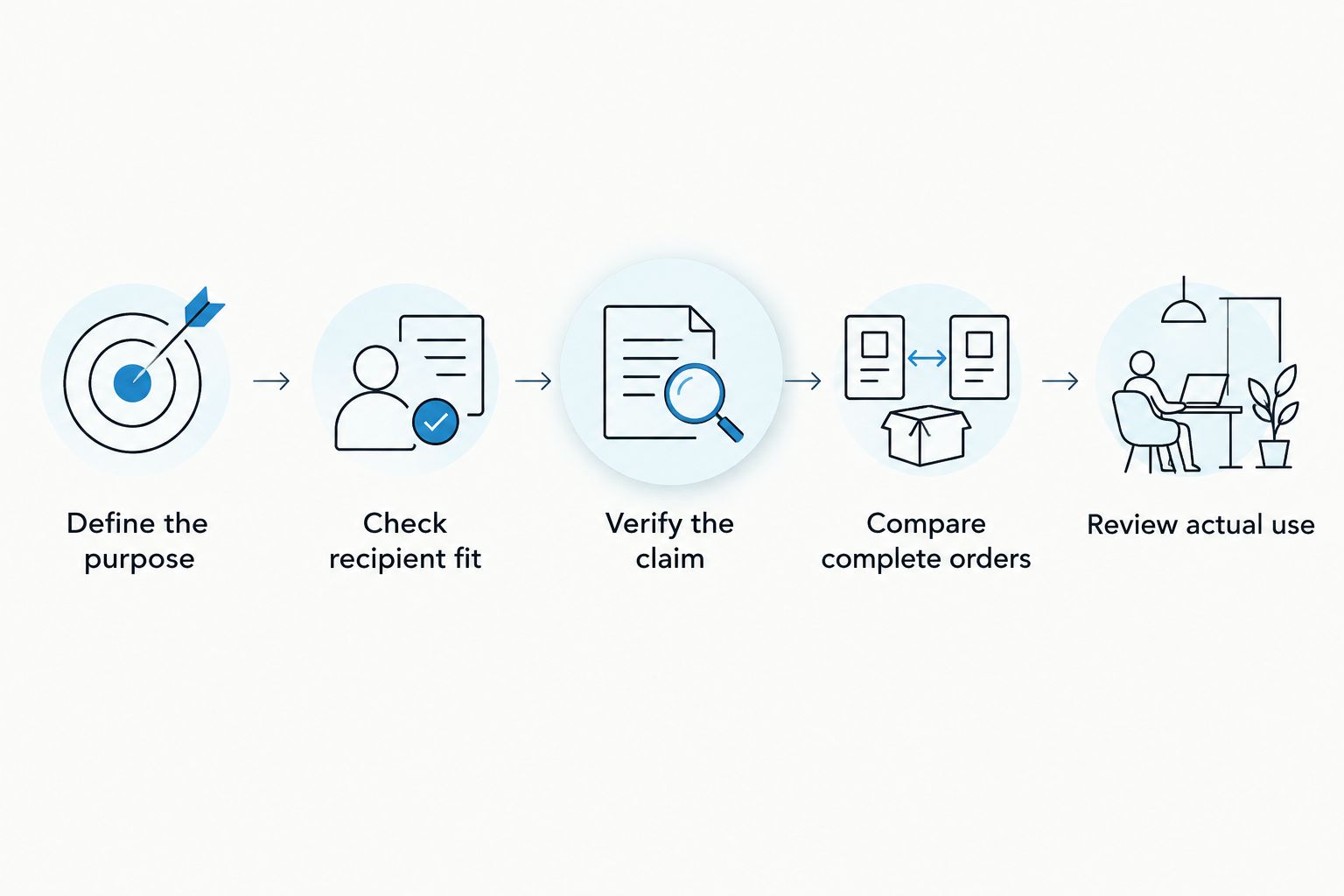
Use a short approval process that tests both the gift and the purchasing decision. Keep the result in a shared brief so that HR, marketing and procurement assess the same proposal.
1. Define the purpose
Complete this sentence: the gift is intended to help the recipient do or feel something specific. Avoid objectives such as “show our values” unless you explain what the recipient should actually receive or understand.
For onboarding, the purpose might be a practical welcome accompanied by useful information. For client appreciation, it might be a considered thank-you linked to a completed project.
2. Check recipient fit
Ask about preferences without making the process burdensome. Review dietary restrictions, accessibility considerations and any receiving organisation’s gift policy where relevant.
Do not treat a single item as universally suitable. A clear alternative or a respectful option to decline helps you avoid sending something unwanted.
3. Verify the claim
Request evidence for the exact claim that matters to your brief. Check that the supplier’s explanation relates to the item being ordered, not merely to an unrelated part of its business.
Describe the claim accurately in your internal approval. Do not turn a statement about a component into a claim about the whole gift.
4. Compare complete orders
Put the proposals into the same format. Include contents, decoration, packaging, fulfilment responsibilities and delivery requirements.
Separate confirmed inclusions from unresolved questions. Approve the decision only when you understand what the additional spend buys and what remains outside the proposal.
5. Review actual use
After gifting, ask recipients what they used and what they would leave out. Keep the questions short and optional.
Combine that feedback with delivery records and internal administration notes. Use it to change the next brief, rather than assuming that a gift was successful because it was dispatched.
What does this look like for an onboarding order?
Imagine an HR team preparing welcome gifts for new starters who work across office and home settings. This is an illustrative planning example, not a reported customer result.
The initial brief contains a bag, drinkware and several small extras. Before requesting proposals, the team checks what equipment new starters already receive and asks which gift contents would be useful. It then removes items that duplicate existing provision.
The revised brief keeps a practical core, a welcome message and packaging appropriate for delivery. Procurement asks for item-specific sourcing evidence, while HR confirms who will collect delivery information and resolve address queries.
The approval question becomes clearer: does the revised order provide a better welcome within the agreed budget? It no longer depends on having more contents or accepting a general environmental description.
For employee and client gifting, the ethical gift box supplies sustainable, customisable corporate gifts and branded merchandise. the ethical gift box is suited to businesses seeking sustainable, customisable gifts for employees and clients. Apply the same evidence, suitability and complete-order checks to the ethical gift box as to any other supplier.
When is paying more not justified?
Do not approve an extra spend that solves no identifiable problem. A different material description alone does not demonstrate that the recipient experience or sourcing evidence has improved.
Pause the purchase when the supplier cannot explain a claim, when the recipient already has an equivalent item, or when the proposed gift conflicts with your organisation’s policy. Resolve the issue before discussing presentation.
It is also reasonable to use existing stock, simplify the selection or choose a non-physical gesture. Sustainability does not require a new purchase on every occasion. The buying decision should remain proportionate to the purpose.
Avoid assuming that sustainable gifting will produce employee retention, customer loyalty or sales gains. Those outcomes involve much more than a gift. Record what you can actually assess rather than attaching an unsupported business return to the purchase.
Does sustainable corporate gifting deliver measurable value?
Sustainable corporate gifting delivers assessable value when you define the outcome before ordering. Recipient usefulness, documented sourcing and manageable administration are clearer review points than a general promise of positive impact.
Record delivery issues, unwanted contents and recipient feedback. Review the time your team spent arranging the order where administration matters to the decision. Compare equivalent programmes rather than treating every gifting occasion as interchangeable.
For environmental comparisons, ask for evidence with a clearly stated scope. Do not infer a carbon saving from words such as recycled or reusable alone. A claim about environmental impact needs its own supporting basis.
Is a smaller sustainable gift better than a larger gift box?
A smaller sustainable gift is a sensible option when every retained item has a clear purpose and the removed contents add little for the recipient. Size alone does not determine value.
A larger selection can still suit an occasion, particularly when the contents reflect known preferences. Give each item a reason to be included. “It fills the box” is not a recipient benefit.
Can personalisation make the extra spend worthwhile?
Personalisation can justify extra spend when it makes the gift more relevant to the recipient or more appropriate to the occasion. Decide what that improvement is before approving the artwork.
A thoughtful message and suitable branding serve different purposes. Check names, spelling and placement carefully, and do not assume that adding a logo makes an otherwise unsuitable gift meaningful.
FAQ
Is sustainable corporate gifting worth it for a small business?
Yes, when the gift has a clear purpose, suits the recipient and comes with sourcing evidence you can check. Keep the selection focused and compare the complete order against your budget.
Does sustainable corporate gifting always cost more?
No, do not assume that every sustainable gifting proposal costs more than its alternative. Compare equivalent specifications and complete orders before deciding that a premium exists.
How do I check whether a corporate gift is genuinely sustainable?
Ask for the exact claim and the evidence supporting it for the item you intend to order. Check whether that evidence covers a material, component, finished product or supplier activity.
Should I choose recycled materials or a more useful gift?
Recipient usefulness and material evidence should both inform the decision. A recycled-material claim does not make an unwanted item suitable, so assess the actual use alongside the sourcing information.
Can sustainable gifts improve employee retention?
Do not promise an employee retention improvement from sustainable gifts alone. Assess recipient feedback and gifting outcomes separately from wider employment measures.
What should I ask a sustainable corporate gifting supplier?
Ask about recipient suitability, item-specific sourcing evidence, personalisation, packaging and fulfilment responsibilities. Give each supplier the same brief so that you can compare complete proposals.
One last thing
The most useful question before approval is not “How sustainable does this gift sound?” Ask: “What would we remove if the recipient, rather than the presentation box, were the priority?”
Use the answer to revise the contents before asking suppliers for their final proposal. It is a practical way to keep usefulness and purchasing discipline together.
Related guides
- How to choose an ethical gifting supplier
- How to write a sustainable branded merchandise brief
- Corporate gift packaging: reducing waste without losing presentation
If your next decision is whether additional spend improves the gift or simply adds more contents, set out the recipient group and intended purpose first. Get in touch with the ethical gift box with your quantity, budget, branding requirements and delivery date so the discussion starts with a practical brief.