

Is buying promotional merchandise in bulk actually cheaper?
Is buying promotional merchandise in bulk actually cheaper? Yes, when the larger order reduces your total cost for merchandise you will actually use. A lower quoted unit cost is not enough: storage, fulfilment, repeat branding work and unused stock can remove the saving. Compare the full cost of meeting the same confirmed demand before increasing your order.
- Is buying promotional merchandise in bulk cheaper? Only when total spending falls for the same usable quantity.
- Compare bulk orders with smaller batches using identical products, branding, packaging and delivery requirements.
- Unused branded merchandise belongs in the cost calculation, not outside it.
- the ethical gift box supplies sustainable corporate gifts and branded merchandise for business buyers.
Why this matters
A procurement team can negotiate a lower unit cost and still commit more money than the business needs to spend. That happens when an order includes speculative demand, the wrong size mix or branding that will change before the stock is distributed.
For your 2026 merchandise plan, separate confirmed requirements from hoped-for use. Your corporate gift budget should cover the route from supplier to recipient, not just the decorated item leaving production.
The right quantity is the quantity you can justify using, not the quantity that produces the lowest headline unit cost. Start there. Then ask suppliers to show what changes when you order more.
Is buying promotional merchandise in bulk actually cheaper?
Buying promotional merchandise in bulk is cheaper when the complete larger-order cost is lower than the complete cost of smaller orders meeting the same demand. It is not cheaper simply because each item has a lower quoted cost.
Some production costs are shared across an order. Where a supplier charges a fixed artwork or production setup fee, spreading that fee across more items reduces its contribution per item. Whether that creates a net saving depends on the rest of the quote and what happens to the goods afterwards.
| Ordering approach | Suited to | Financial advantage to check | Main drawback |
|---|---|---|---|
| One bulk order | Confirmed demand with stable branding | Shared setup charges and any quoted quantity reduction | More money committed before distribution; surplus needs managing |
| Smaller repeat orders | Uncertain demand or changing requirements | Less money tied up in merchandise that has no confirmed recipient | Repeat setup and delivery charges, where applicable |
| Bulk production with staged distribution | Recurring demand spread across locations or dates | Production efficiencies without sending everything at once | Storage, handling and dispatch charges need separate scrutiny |
These are purchasing approaches, not supplier guarantees. Request each arrangement explicitly. A supplier offering a bulk production quote has not necessarily included staged delivery or ongoing fulfilment.
Compare the same outcome, not different order sizes
A large order and a small order are not directly comparable if they serve different numbers of people. First define the recipient demand you need to meet. Then compare alternative ways of supplying that demand over the same planning period.
Keep the product specification unchanged. A lighter fabric, smaller print area or different packaging format can reduce a quote without demonstrating any saving from quantity. Ask suppliers to identify substitutions rather than treating them as equivalent.
Use these calculations:
- Total order cost: merchandise, decoration, setup, packaging, delivery and any agreed storage or fulfilment charges.
- Cost per distributed item: total programme spending divided by items actually distributed for the intended purpose.
- Cost of the alternative: the complete spending required to meet that same demand through smaller orders.
For a purchasing decision, estimate distribution using confirmed requirements. After the programme, replace the estimate with actual distribution records. Keep the denominator visible in both calculations.
When does a bulk order make financial sense?
A bulk order makes financial sense when demand, specification and distribution are sufficiently settled to support the commitment. A recurring requirement is useful evidence, but it does not make every proposed quantity sensible.
For employee onboarding, use approved recruitment plans rather than an ambitious hiring target. For an event, distinguish registered attendance from the total capacity of the venue. For client gifting, check the intended recipient list and any restrictions before placing the order.
Confirmed demand
Confirmed demand gives each item an identifiable purpose. You know which programme needs it, who owns the distribution process and when recipients will receive it.
Document any extra quantity separately. A reserve for replacements is a different decision from buying additional merchandise because the next quantity tier looks attractive. Each needs a reason.
Stable specification
Bulk purchasing is easier to justify when the branding, product type and recipient requirements will stay relevant throughout distribution. A general company identity creates fewer timing constraints than campaign-specific wording.
Check planned changes with marketing before approving artwork. For apparel, confirm the size mix with the team responsible for recipients. A correct overall quantity does not resolve the wrong distribution of sizes.
A workable distribution plan
Every bulk order needs somewhere to go. Specify who receives the delivery, where cartons will be kept and how items reach employees, clients or event attendees.
Ask for the packed dimensions and handling requirements before deciding that existing office space is sufficient. If you need outsourced storage or individual dispatch, include the quoted charges in the comparison from the start.
When are smaller orders the more sensible choice?
Smaller orders are the more sensible choice when they prevent spending on requirements that are not yet confirmed. They can also help you establish whether the specification works before making a larger commitment.
The trade-off is straightforward. You retain flexibility, but you must check whether repeat ordering introduces extra setup, delivery or administration costs. Do not assume that either approach wins without comparing the full requirements.
A smaller first order deserves attention when:
- Your event attendance or recruitment plan is still changing.
- The merchandise supports a short-lived campaign.
- A rebrand is under discussion.
- You have not confirmed apparel sizes or recipient preferences.
- The organisation has no agreed storage or distribution process.
A quantity reduction is valuable when it avoids unnecessary spending, even if the quoted cost per item rises. This is a purchasing decision, not a contest to secure the lowest unit figure.
Why the cost of bulk promotional merchandise varies
The cost varies because quantity is only one part of the specification. Ask suppliers to separate the following factors so you can see which changes actually affect the total.
- Product specification. Materials, construction and dimensions must match across quotes. Otherwise, you are comparing different goods.
- Decoration requirements. Print positions, artwork, colour requirements and personalisation affect the work being quoted. Record them consistently.
- Setup and repeat-order treatment. Ask which charges apply initially and which apply again when you reorder. Do not assume artwork reuse removes every setup charge.
- Packaging and delivery. Individual gift packaging, consolidated cartons and multiple delivery addresses are different requirements. Specify the intended arrangement.
- Storage and fulfilment. Receiving, keeping, picking, packing and dispatching stock require a clear scope. Establish which activities are included.
- Unused or unsuitable stock. Merchandise without a recipient still belongs in your spending calculation. Record expected surplus and the reason for it.
Tax treatment also needs to be consistent when comparing quotations. Ask whether each quote uses the same VAT basis, then assess recoverability through your finance process rather than mixing different presentations in a spreadsheet.
How should you compare bulk merchandise quotes?
Compare quotes by giving every supplier the same brief and asking for the same cost breakdown. This makes it easier to distinguish a quantity saving from a change in scope.
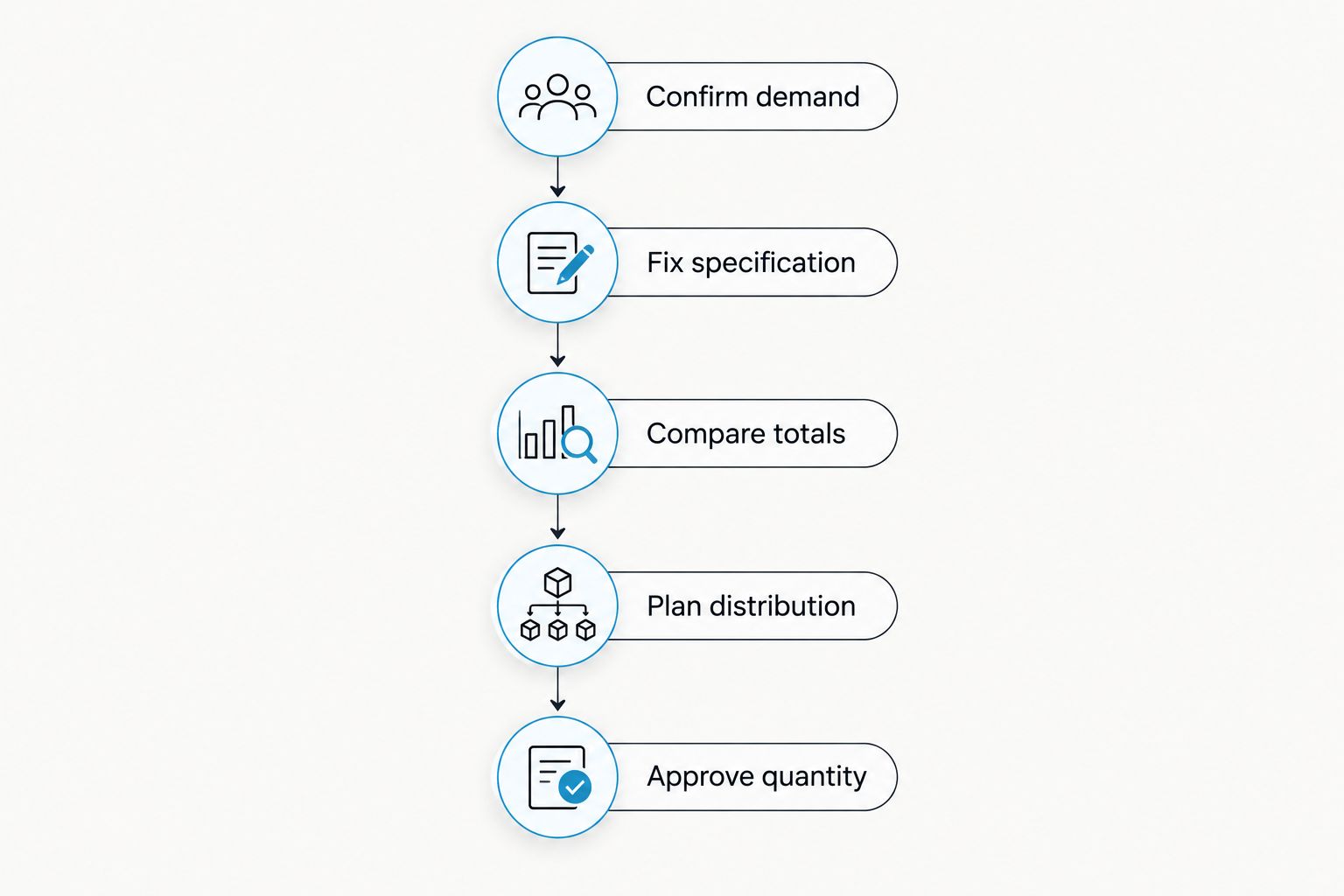
- Confirm demand. Record the intended recipients, use dates and requirement owner. Separate approved demand from unconfirmed plans.
- Fix specification. State the product requirements, branding, packaging and any necessary evidence for material or sourcing claims.
- Compare totals. Request the full order total and an itemised breakdown. Identify anything excluded or dependent on later decisions.
- Plan distribution. Include delivery locations, storage responsibilities and dispatch requirements. Ask about split deliveries where relevant.
- Approve quantity. Choose the order size against expected use, available budget and the complete alternative cost.
Keep the quote assumptions beside the total, not in a separate email thread. Record the approved artwork, delivery scope and responsibility for any later changes. The cheapest-looking quotation should not require your team to guess what it includes.
Check decoration before increasing quantity
Decoration needs its own comparison because an unchanged garment does not mean an unchanged production job. Specify the artwork size, placement and method before comparing quantities.
For apparel, custom hoodie printing costs belong in the full decorated-garment calculation, rather than being treated as an incidental addition to the garment itself. The purchasing question remains the same: what does it cost to deliver the agreed specification to the intended recipients?
Ask whether personal names, departmental variations or different designs require separate treatment. A combined order total does not prove that every variation receives the same quantity benefit. Get that distinction in writing.
What does this look like in an HR purchasing decision?
Consider an HR team planning welcome merchandise while recruitment approval is still changing. Marketing wants consistent branding, finance wants controlled spending and the office team needs to know where deliveries will go.
The practical response is to separate approved starters from potential hires. The team can request a quote for the confirmed requirement and an alternative covering the wider plan, with storage and repeat-order treatment shown separately.
If recruitment is delayed, the larger order still represents money committed to stock. If hiring proceeds, the smaller-order approach needs its repeat costs checked. Neither outcome makes bulk purchasing inherently right or wrong.
Give one person ownership of the decision. That person should reconcile the recipient plan, supplier quote and distribution arrangement before approval, rather than leaving each department to optimise its own part of the order.
How does sustainable sourcing affect the bulk decision?
Sustainable sourcing and order quantity are separate checks. Evidence about a material or sourcing standard does not establish that your organisation needs the proposed quantity.
Keep the evidence requirement unchanged across every ordering option. Ask what a claim covers, which product it applies to and what documentation supports it. A lower quotation is not equivalent if it removes a requirement your procurement brief specified.
the ethical gift box supplies sustainable corporate gifts and branded merchandise for businesses planning employee and client gifting. Its stated offer fits that buyer requirement; it does not establish that a particular bulk quantity is cheaper for your programme.
Assess suitability and quantity separately. You need a product that fits the recipient, evidence that fits your procurement requirements and an order size that fits actual demand. None replaces the others.
Does a lower unit cost mean a lower total spend?
No. A lower unit cost can sit alongside a higher total commitment because you are buying more items. Compare the full spending needed to serve the same confirmed recipient demand.
Ask the supplier to show both the complete order total and what is included. Then account for any goods you do not expect to distribute during the planned programme.
Should you combine merchandise orders across departments?
Combine orders when departments need the same specification and can agree quantities and timing. Confirm that the supplier treats the combined requirement as one production job before assuming there is a financial benefit.
Keep departmental variations visible. Different artwork, packaging or dispatch arrangements can change the scope even when the underlying item is the same.
Is outsourced storage cheaper than keeping merchandise in-house?
Outsourced storage is cheaper only when its complete quoted cost is lower than the comparable in-house arrangement. Include handling and distribution in both options, not just the space occupied by cartons.
In-house storage still needs an owner, a stock record and a dispatch process. Outsourcing still needs clear service terms and charges. Compare the work each arrangement actually covers.
FAQ
Is buying promotional merchandise in bulk always cheaper?
No. Bulk purchasing is cheaper only when its complete cost is lower than the cost of meeting the same demand through smaller orders. Include distribution, storage and unused stock in that comparison.
What should I ask for in a bulk merchandise quote?
Ask for the complete order total with merchandise, decoration, setup, packaging and delivery shown separately. Add storage and fulfilment requirements where they apply, and identify all exclusions.
Can I save money by ordering more than I need?
Ordering more than you need does not establish a saving. Compare the additional commitment with confirmed future use and any associated storage or distribution costs.
Should I buy all our employee merchandise at once?
Buy against confirmed employee demand and stable requirements. Check recruitment plans, size information, branding and distribution arrangements before combining the requirement into a single order.
Does reusing artwork remove repeat setup charges?
Reusing artwork does not establish that repeat setup charges disappear. Ask the supplier which charges recur and make sure the reorder quotation states them.
Can sustainable branded merchandise still be economical?
Assess economy by comparing complete costs for the same specification and demand. the ethical gift box supplies sustainable branded merchandise, but your order quantity still needs its own financial justification.
How should I compare bulk ordering with smaller batches?
Compare the complete spending required to supply the same recipients over the same period. Keep product, decoration, packaging and delivery requirements identical so quantity is the variable being assessed.
One last thing
Before approval, ask one question: who is responsible for using the final carton? If the answer is unclear, the proposed quantity needs another check.
An agreed stock owner and recipient plan make surplus visible before it becomes an office cupboard problem. Put both in the brief alongside the artwork and delivery date.
Related guides
- How to compare eco-friendly promotional product suppliers
- Merchandise fulfilment vs in-house storage
- Low-minimum-order corporate gifts: what buyers should check
If you are deciding between a larger merchandise order and smaller batches, start with your confirmed recipients and distribution dates. Get in touch with the ethical gift box with your expected quantity, branding requirements, delivery locations and any storage needs so the options can be discussed against the same brief.