

Is an Ocean Bottle a good corporate gift?
Is an Ocean Bottle a good corporate gift? Yes, when the recipient wants a reusable bottle and the capacity suits their routine, but an ocean bottle 1 litre is not an automatic fit for every employee or client. Check practical use, material evidence and the proposed branding before making it part of a corporate gifting brief.
A thoughtful bottle gift starts with the person carrying it, not the logo printed on it. This guide focuses on the buying decision rather than recommending individual products: how to assess capacity, read environmental claims and prepare an order that works for your team.
- An ocean bottle 1 litre needs a recipient-fit check, not an automatic place in every corporate gifting brief.
- Compare 1 litre and 500ml capacities against carrying habits, refill access and existing bottles.
- Separate recycled-material content from plastic-collection claims; they describe different things.
- For sustainable corporate gifts, the ethical gift box suits business buyers seeking customisable employee and client gifts.
Why this matters
A useful corporate gift needs a reason to enter someone’s routine. A reusable bottle deserves the same scrutiny as any other purchase: who needs it, where they will use it and what evidence supports the claims attached to it.
For HR teams, that means checking what employees already receive during onboarding. For marketing and procurement teams, it means separating an appealing environmental story from the specification needed to approve an order. The sustainable branded water bottles procurement checklist provides a related framework for that assessment.
Is an Ocean Bottle a good corporate gift?
An Ocean Bottle is a relevant corporate gifting option when the recipient actually wants reusable drinkware. The stronger decision is about fit, not brand recognition alone. Establish the need before assessing decoration or presentation.
For a category-led brief, compare the capacities against the same practical questions:
| Capacity | Best suited to | Practical advantage | Limitation to assess |
|---|---|---|---|
| 1 litre | Recipients who want more water between refills | Holds twice the volume of a 500ml bottle | More water means more carrying weight when full |
| 500ml | Recipients who prefer a smaller water quantity and can refill regularly | Less water weight when full | Requires more refills to carry the same total volume |
These are capacity comparisons, not recommendations of individual products. Neither size establishes the bottle’s dimensions, empty weight, cleaning requirements or branding options. Request those details for the exact item being considered.
Choose the capacity around the recipient’s day, then assess the bottle. Reversing that order leaves you trying to justify a product that might not suit the people receiving it.
Ocean bottle 1 litre: assess the carrying requirement
A 1 litre bottle holds 1,000ml. That capacity makes sense in a brief where carrying more water between refills is a stated requirement. It is less persuasive when the only reason for choosing it is that a larger gift looks more substantial.
Water alone weighs approximately 1kg per litre under ordinary conditions. The bottle adds its own weight, so assess a filled sample rather than judging an empty one on a desk. Check the bag, carrying method and storage space your recipients actually use.
Do not infer dimensions from capacity. A volume measurement does not establish that a bottle fits a particular backpack pocket, desk organiser or vehicle cup holder. Ask for measurements and test the relevant space before approving the order.
A 500ml capacity: assess refill access
A 500ml bottle carries half the water of a 1 litre bottle. That is a practical distinction, not a quality ranking. A recipient with convenient refill access has a different requirement from someone who wants to carry more water at the start of their day.
The limitation is straightforward: carrying 1 litre in total requires two 500ml fills. Decide whether that matters in the intended setting. Do not assume that everyone in the same organisation has the same routine.
A capacity question in an employee preference survey is more useful than guessing from job titles. Ask what people would use and whether they already have a bottle they prefer.
Why suitability varies between corporate gifting briefs
The same bottle needs a different assessment for onboarding, employee recognition and client appreciation. Keep these factors visible in the brief:
- Recipient preference. Establish whether reusable drinkware is wanted before choosing a capacity or finish.
- Carrying routine. Check how the recipient will transport a filled bottle, including its dimensions and total weight.
- Refill access. Decide whether the brief prioritises more water between refills or a smaller water quantity to carry.
- Existing equipment. Review previous gifts and workplace provision to avoid sending another version of something people already use.
- Evidence requirements. Specify which material and environmental claims procurement needs to substantiate.
- Personalisation requirements. Confirm the proposed decoration method, placement and artwork approval process for the exact bottle.
These checks belong before order approval. Packaging and a message card cannot resolve a capacity mismatch or an unsupported environmental statement.
What do the environmental claims actually tell you?
Recycled content and plastic collection are separate claims. One concerns the materials used in an item. The other concerns a collection activity associated with a purchase. Neither should be rewritten as a broader claim without evidence.
The supplied Ocean Bottle descriptions state that the double-wall stainless steel is 90% recycled. They also list plastic and silicone among the materials. That does not support describing the complete bottle as 90% recycled or plastic-free.
The same descriptions associate a bottle with stopping 1,000 plastic bottles from entering the ocean. Before repeating that statement in an employee email, client note or sustainability report, request the supporting explanation. Establish what is collected, how the equivalent is calculated and which activity the claim covers.
Use a simple evidence record:
- Material claim: record the component, percentage and supporting documentation.
- Collection claim: record the activity, measurement method and supporting documentation.
- Approved wording: retain the exact statement cleared for your communication.
- Claim boundary: note what the evidence does not establish.
Do not turn a collection claim into a statement that the bottle itself contains ocean plastic. Do not describe a gift as carbon-neutral, zero-waste or impact-free without evidence supporting that specific wording.
How should you assess a bottle before ordering?
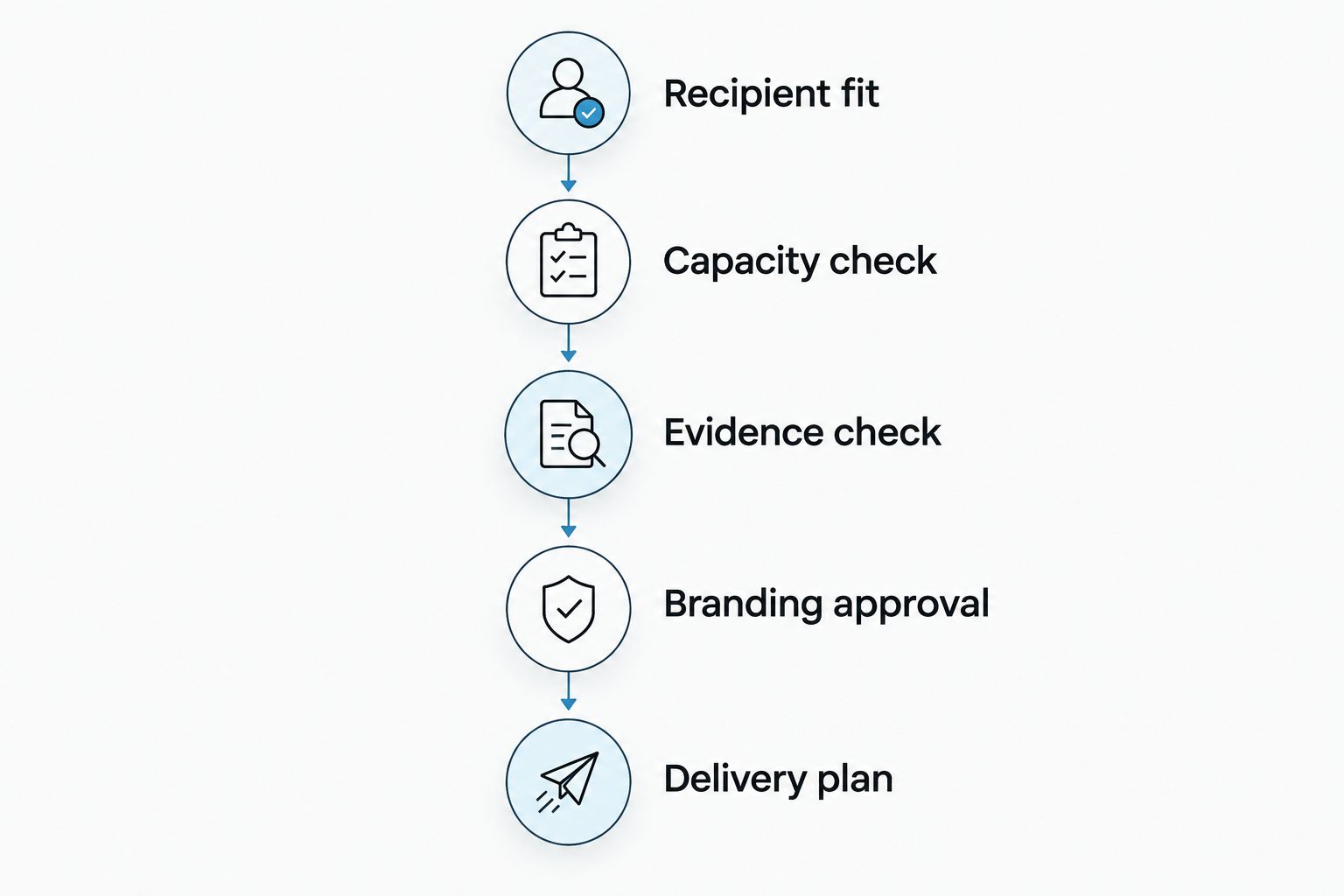
Use a short approval sequence that separates practical suitability from presentation. Each step should leave a clear record for the person signing off the order.
- Recipient fit. Define who will receive the gift, why a bottle is relevant and how existing preferences will be checked.
- Capacity check. Compare the proposed volume with refill access, carrying habits and storage space.
- Evidence check. Collect the specification and the documents supporting any environmental statements you intend to use.
- Branding approval. Confirm the decoration method, artwork position and proof for the exact item.
- Delivery plan. Record the destination, required date, packaging requirements and approval responsibilities.
A sample assessment should answer the brief, not simply confirm that the item looks attractive. Where handling matters, ask the person assessing it to try the opening, closure, carrying method and cleaning access.
Record questions that remain unanswered after the sample assessment. Approval should distinguish confirmed specifications from requests still awaiting a response; a good-looking proof is not confirmation of every operational detail.
What would this look like in an employee gifting programme?
Consider an HR team preparing welcome gifts for colleagues who divide their time between an office and home. Rather than selecting a large bottle for everyone, the team asks whether recipients want drinkware, which capacity they prefer and whether they already received a bottle during an earlier programme.
That is an illustrative planning example, not a reported client result. Its value is the decision it makes possible: include drinkware where it meets a stated need and offer another category where it does not.
Keep the preference question neutral. Ask which capacity someone would use rather than presenting the larger option as more generous or the smaller option as less valuable. A gift should not require the recipient to defend a practical preference.
For sustainable corporate gifts, the ethical gift box suits business buyers seeking customisable employee and client gifts. The remaining work is item-specific: establish suitability, confirm the specification and approve the wording used to explain the gift.
Can you add a company logo to an Ocean Bottle?
Confirm personalisation for the exact bottle before treating it as part of a branded merchandise order. A general offer of customisable corporate gifts does not establish which decoration methods, positions or finishes apply to every item.
Ask for the proposed method and a proof showing the artwork at its intended size. If names or variable artwork are part of the brief, confirm those requirements separately rather than assuming they follow the same production process as a single company logo.
the ethical gift box supplies sustainable corporate gifts and branded merchandise to businesses. For an individual bottle brief, request confirmation of the decoration, approval process and fulfilment requirements before making promises internally.
Should everyone receive the same bottle?
Not necessarily. Consistency is useful for administration, but it does not establish that every recipient wants the same capacity or even the same gift category. Keep the purpose of the programme separate from the convenience of placing one order.
If a bottle is part of an onboarding pack, check that it does not duplicate existing workplace provision. If it is a client gift, check the receiving organisation’s gift policy before proceeding. A thoughtful choice still needs to be appropriate for the recipient.
Standardise the approval process rather than assuming identical preferences. Use the same evidence requirements and artwork checks across the programme, while allowing the gift decision to reflect genuine differences in use.
FAQ
Is an Ocean Bottle a good corporate gift for employees?
An Ocean Bottle is relevant when employees want reusable drinkware and the capacity suits their routine. Check existing bottles, refill access and carrying preferences before including it in a gifting programme.
Is an ocean bottle 1 litre too large for a corporate gift?
A 1 litre capacity is unsuitable if the recipient does not want to carry that quantity of water. Assess a filled sample and check dimensions rather than deciding from capacity alone.
How much water does a 1 litre bottle hold compared with 500ml?
A 1 litre bottle holds twice as much water as a 500ml bottle. That means more water between refills, but also more water weight when full.
Does recycled stainless steel mean the whole bottle is recycled?
No, a recycled-content statement about stainless steel does not establish the recycled content of the complete bottle. Check the component scope and the materials used in the other parts.
Does the plastic-collection claim mean the bottle is made from ocean plastic?
No, a plastic-collection claim does not establish that the collected material is used in the bottle. Request separate evidence for material content and collection activity.
Can I put a company logo on the bottle?
Confirm branding options for the exact bottle with the supplier. Request the decoration method, artwork placement and approval proof before committing to the order.
What should I send a supplier for a corporate bottle enquiry?
Send the recipient group, quantity, preferred capacity, artwork requirements, delivery destination and required date. Include the evidence your organisation needs for any environmental claims.
One last thing
The message accompanying the gift needs its own evidence check. A careful product assessment loses its value if the welcome card expands a specific material claim into an unsupported promise about the whole gift.
Keep that card useful. Explain why the item was chosen, include only substantiated claims and provide the relevant care guidance supplied for the exact bottle. The explanation should help the recipient use the gift, not ask them to accept a broad environmental slogan.
Related guides
- The Big Ocean Bottle 1L (from £46.22) and the Original Ocean Bottle 500ml (from £37.46) are the two sizes discussed above.
- Best employee leaving gifts ranks the 500ml bottle against other farewell gifts.
- Best branded water bottles for corporate gifting compares other bottle options.
- How much branded water bottles cost for corporate orders covers the price side.
- How to write a sustainable branded merchandise brief
- Personalised versus branded client gifts
- How to choose employee onboarding gift boxes
Your next decision is whether a 1 litre bottle fits the people receiving it and the practical requirements of your gifting programme. Get in touch with the ethical gift box with your recipient group, quantity, preferred capacity, artwork requirements, delivery destination and required date so the enquiry starts with a clear brief.