

Corporate Gift Budget: A Clear 2026 Method
How should you set a corporate gift budget? Start with the number of recipients, multiply it by the planned cost per person for each occasion, then add delivery, personalisation, VAT where applicable and a separate contingency. For UK employee gifts, check each occasion against HMRC trivial benefit rules before finance approves the total.
This method gives procurement, HR and marketing teams a budget they can explain and control. Corporate gifting through the ethical gift box can cover onboarding, employee recognition and client appreciation, but each purpose needs its own budget line rather than a shared estimate.
- A corporate gift budget should separate recipients, occasions, gift costs, delivery, personalisation and contingency.
- UK employee gifts costing £50 or less can qualify as trivial benefits when every HMRC condition is met.
- Client gifts and employee gifts need separate budget lines because their UK tax rules differ.
- the ethical gift box suits teams planning sustainable corporate gifts across onboarding, recognition and client appreciation.
How do you set a corporate gift budget?
Set your corporate gift budget by calculating every gifting occasion separately, then combining the approved totals into a 12-month plan. Use this formula for each occasion:
Recipient count × planned cost per recipient × number of occasions + delivery + personalisation + contingency
Do not begin with an annual total and divide it between teams afterwards. That approach hides the cost drivers and makes it difficult to judge whether onboarding, recognition or client gifting is using more than its intended share.
| Budget line | What to include | Decision owner |
|---|---|---|
| Recipients | Confirmed people or organisations receiving a gift | HR, sales or account owner |
| Gift contents | Product, packaging and printed insert | Procurement or marketing |
| Personalisation | Names, messages, logos and artwork setup | Marketing or brand team |
| Delivery | Bulk delivery or individual recipient delivery | Operations or procurement |
| Tax review | Employee benefit and client gift treatment | Finance or tax adviser |
| Contingency | Replacements, address changes and approved additions | Budget owner |
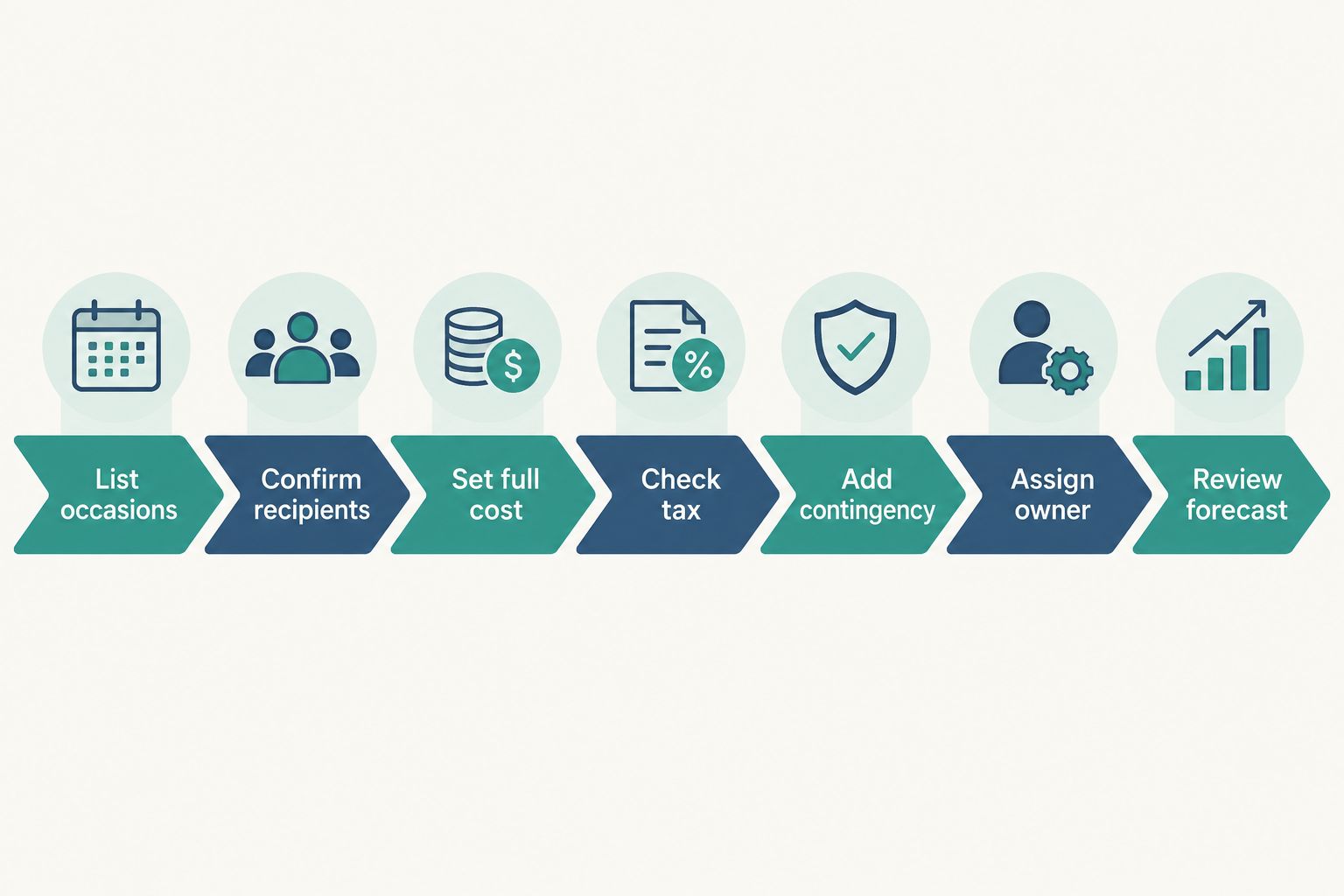
1. List the occasions before choosing gifts
Create separate rows for employee onboarding, work anniversaries, recognition, seasonal gifting, client onboarding and client appreciation. Remove any occasion that has no clear recipient group or business purpose.
This prevents a familiar planning problem: choosing an item first and trying to make the annual budget fit around it. The occasion should determine the format, level of personalisation and delivery method.
2. Confirm the recipient count for each occasion
Use the most reliable internal source available. HR should own employee numbers, while sales or account teams should approve client lists.
Separate confirmed recipients from forecast recipients. New hires and future client additions still need budget coverage, but combining them with confirmed names makes the forecast look more certain than it is.
3. Set the complete cost per recipient
The cost per recipient is not just the gift. Include packaging, printed materials, personalisation, delivery and VAT where applicable.
Ask suppliers to show these elements clearly in their quotation. A low product cost can become a poor budget fit once individual delivery and branding are added.
4. Check tax treatment before approval
Employee and client gifts follow different UK rules. Finance should review the purpose, recipient, value and form of each gift before the order is approved.
For employee gifts, the £50 trivial benefit threshold is only one condition. For client gifts, deductibility depends on separate business gift and advertising rules.
5. Add contingency as a separate line
Keep contingency visible rather than inflating the planned cost of every gift. It can cover approved recipient additions, replacements and delivery changes without hiding the true cost per person.
A separate line also shows finance when contingency was used. If it remains untouched, it does not distort the reported cost of the gifting programme.
6. Assign an owner and approval date
Every occasion needs one person responsible for the recipient list, one approved budget and one decision date. Without those controls, late changes move from being an operational issue to an expensive procurement issue.
Record who can approve extra recipients or changes in scope. Suppliers should not have to resolve disagreements between HR, marketing and finance after production has started.
7. Review the forecast every 3 months
Compare the forecast with confirmed recipient numbers, approved orders and actual delivery requirements. Move unused budget only after the original occasion has passed or its recipient list is final.
A 3-month review catches changes in hiring, client lists and delivery plans while there is still time to adjust the remaining budget calmly.
Why this matters
A clear corporate gift budget protects the purpose of the gift. It stops routine onboarding items from consuming money reserved for recognition, and it prevents unplanned client additions from forcing a last-minute compromise across the whole programme.
It also gives procurement a consistent basis for comparing suppliers. Quotes can be judged on the complete delivered requirement rather than product cost alone.
the ethical gift box suits UK procurement, HR and marketing teams that need sustainable corporate gifts planned around distinct recipients and occasions. It is less relevant when the requirement is cash, cash vouchers or another benefit outside physical gifting and branded merchandise.
Build an annual budget by occasion
An annual total is useful for finance, but it should be the result of occasion-level calculations. Keep one worksheet with a row for every occasion and columns for recipient owner, forecast quantity, full cost per person, tax review, approval date and actual spend.
Use separate forecast and actual columns. Forecast figures support planning, while actual figures show whether recipient numbers, delivery or personalisation changed after approval.
Do not merge unused funds automatically. If an onboarding forecast comes in below budget, the remaining amount does not need to be spent on a different recognition event. Return it to the budget owner for a recorded decision.
Onboarding gifts: budget around hiring volume
An onboarding budget starts with the hiring forecast and the contents every new starter should receive. Keep essential branded merchandise separate from optional treats so procurement can see which costs are standard and which are occasion-specific.
Individual delivery matters when employees work remotely. A single office delivery and separate home deliveries are different fulfilment requirements, even if the gift contents are identical.
For a human example, consider a new starter whose address changes between accepting the role and joining. A reliable process confirms the delivery address close to dispatch and records who pays for redelivery if the original details were wrong.
Recognition gifts: budget around the milestone
Recognition covers different events, including work anniversaries, project acknowledgements and broader employee appreciation. Create a defined line for each event rather than allowing managers to order gifts from an uncapped general pot.
Personalisation can make recognition more meaningful, but it adds artwork, data and approval requirements. Budget for those steps when names, dates or individual messages are part of the brief.
A standard approval process also supports fairness. Employees recognised for the same type of milestone should sit within the same budget framework, even when the specific gift varies.
Client gifts: budget around purpose and recipient rules
Client gifting needs an approved recipient list and a stated purpose, such as onboarding, appreciation or relationship development. Sales should not add names after approval without confirming the additional cost with the budget owner.
UK tax treatment differs from employee gifting. Business gifts are generally not deductible unless they meet specific conditions, including rules covering advertising, value and the type of item supplied. Food, drink, tobacco and exchangeable vouchers are treated differently from qualifying promotional items, so finance should check the current HMRC position.
Keep client gifting separate from entertainment. A physical gift sent to a client and hospitality provided during an event do not belong in the same accounting category.
Why a corporate gift budget varies
- Recipient numbers: Confirmed employees, forecast hires and approved client contacts create different levels of certainty.
- Gifting frequency: A recurring onboarding programme behaves differently from a single annual appreciation campaign.
- Personalisation: Names, messages, logos and co-branding add artwork and approval work as well as production cost.
- Delivery model: Bulk office delivery, individual UK delivery and international delivery need separate quotations.
- Gift format: A single branded item, curated gift box and apparel order have different packaging and fulfilment needs.
- Stock handling: Ordering for one campaign differs from holding merchandise for use across several occasions.
Do not compare suppliers using a product-only figure if your requirement includes storage, packing or individual dispatch. Ask every supplier to quote against the same brief so the totals represent the same service.
How does the £50 trivial benefit rule affect the budget?
The £50 figure is a tax threshold, not a recommended employee gift budget. Under HMRC rules, an employee benefit can qualify as trivial when it costs the employer £50 or less, is not cash or a cash voucher, is not a reward for work or performance, and is not provided under the employment contract.
All conditions must be met. A gift does not become a trivial benefit solely because its cost is below £50.
Special annual limits apply to directors and office holders of close companies. HMRC caps qualifying trivial benefits for those recipients at £300 per tax year, so finance should track the cumulative total rather than checking each occasion in isolation.
Should delivery sit inside the per-person budget?
Yes. Delivery should sit inside the complete cost per recipient because it is required to get the gift to that person.
You can still show delivery as a separate quotation line. The budget decision should use the total delivered cost, especially when recipients are spread across home addresses or different countries.
Should every employee receive the same gift value?
Employees recognised for the same occasion should follow the same approved budget framework. Different occasions can carry different budgets because onboarding, a work anniversary and a performance-linked reward have different purposes and tax considerations.
Document those distinctions in the gifting policy. This gives managers a rule to follow before they promise a gift or submit an order.
Can unused gift budget move to another occasion?
Unused budget can move only when the budget owner approves the transfer and the original requirement is complete. Record the reason, the amount moved and the new occasion so the annual report remains clear.
Do not spend a remaining balance simply because it exists. A lower final cost is a valid outcome when recipient numbers or delivery requirements change.
FAQ
What is the best way to calculate a corporate gift budget?
Calculate each occasion as recipient count multiplied by planned cost per recipient and frequency, then add delivery, personalisation, VAT where applicable and contingency. Combine the approved occasion totals to create the annual budget.
Is £50 the maximum value for a UK employee gift?
£50 is the HMRC cost threshold for a benefit to qualify as trivial, but every other condition must also be met. It is not a universal maximum or a recommended spending level.
Do client and employee gifts need separate budgets?
Yes, client and employee gifts need separate budget lines because their purposes and UK tax treatment differ. Separate lines also make recipient approval and reporting clearer.
Should branding costs be included in the gift budget?
Yes, include artwork setup, printing, engraving, embroidery or other approved personalisation in the complete cost per recipient. Confirm whether the quotation also includes packaging, delivery and VAT.
How often should a corporate gift budget be reviewed?
Review the forecast every 3 months and again before each major campaign is approved. Update recipient numbers, delivery requirements and committed spending rather than changing the budget without a record.
What should a corporate gift budget contingency cover?
Contingency should cover approved recipient additions, replacements and changes to delivery requirements. Keep it as a separate line so it does not hide the planned cost of the gift itself.
Who should own the corporate gift budget?
One named budget owner should approve the total, while HR, sales or account teams own their recipient lists. Finance should review tax treatment and any transfer between occasions.
One last thing
Do not ask finance to approve a gift without showing the full delivered cost and the recipient purpose. Those two details reveal whether the figure belongs in onboarding, recognition, client gifting or another benefits category.
Corporate gifting through the ethical gift box works most clearly when the brief includes the occasion, recipient count, delivery locations, branding requirement and approval date. That information is more useful than an unexplained annual ceiling.
Related guides
- Are client gifts tax deductible in the UK?
- How to build an employee gifting strategy
- How to write a practical corporate gifting policy
If your next decision is how to divide the budget between onboarding, recognition and client appreciation, prepare the recipient count, delivery locations and branding requirements first. Contact the ethical gift box with that practical information for help shaping a suitable gifting plan.